
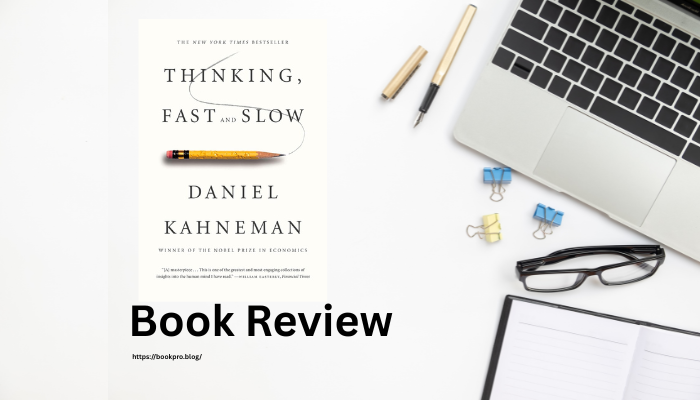
Why do we sometimes make decisions instantly, while other times we carefully analyze every detail? Why do people make predictable mistakes even when they have plenty of information? In Thinking, Fast and Slow, Nobel Prize-winning psychologist Daniel Kahneman explores how the human mind works and why our thinking is not always as rational as we believe.
First published in 2011, this influential book explains the mental processes behind our judgments, choices, and everyday decisions. Through psychological research and real-world examples, Kahneman shows how our minds use shortcuts to process information—and how these shortcuts can sometimes lead us in the wrong direction.
Whether you are interested in psychology, business, personal development, or financial decision-making, this book offers valuable insights into understanding your own thought patterns.
Book Overview
- Book Title: Thinking, Fast and Slow
- Author: Daniel Kahneman
- Genre: Psychology, Behavioral Economics, Nonfiction
- First Published: 2011
- Publisher: Farrar, Straus and Giroux
- Length: Approximately 499 pages in the original US edition; editions vary
- Estimated Reading Time: 10–14 hours
- Best For: Readers interested in psychology, critical thinking, decision-making, and human behavior
About the Author
Daniel Kahneman was an Israeli-American psychologist known for his groundbreaking research into human judgment and decision-making. He received the 2002 Nobel Memorial Prize in Economic Sciences for work he conducted with Amos Tversky on decision-making under uncertainty.
Kahneman’s research challenged the traditional assumption that people generally make rational decisions. His work helped establish behavioral economics as an important field, connecting psychology with economics.
In Thinking, Fast and Slow, he brings decades of research together to explain why people rely on mental shortcuts and how these shortcuts affect their choices.
What Is the Book About?
The central idea of Thinking, Fast and Slow is that our minds use two different modes of thinking. Kahneman calls them System 1 and System 2.
System 1: Fast Thinking
System 1 operates quickly and automatically, often without conscious effort. It helps us recognize familiar faces, understand simple sentences, and react to sudden situations.
Fast thinking is useful because it allows us to handle everyday tasks without analyzing every detail. However, it can also cause errors when we make judgments based on incomplete information, emotional reactions, or assumptions.
System 2: Slow Thinking
System 2 involves deliberate attention and mental effort. We use it when solving complicated problems, checking calculations, comparing options, or carefully evaluating an argument.
Slow thinking can help us identify mistakes, but it requires concentration and energy. As a result, we do not always use it when we should.
Kahneman explains that the two modes work together, but fast thinking often influences our judgments before we have a chance to examine them carefully.

Key Lessons from Thinking, Fast and Slow
1. Your First Impression Can Be Misleading
Our minds quickly form opinions about people, situations, and information. Although these impressions can be useful, they are not always accurate.
Lesson: Avoid making important decisions based only on your first reaction. Gather evidence and consider alternative explanations.
2. Cognitive Biases Affect Everyday Decisions
A cognitive bias is a systematic pattern that can influence how we interpret information. Kahneman discusses several biases that affect judgments, including anchoring, availability, and overconfidence.
For example, the first price you see for a product can influence how reasonable later prices appear, even when the initial price is not a useful benchmark.
Lesson: Question the assumptions behind your decisions, especially when money, work, or relationships are involved.
3. Confidence Does Not Always Mean Accuracy
People can feel confident about their predictions even when they have limited evidence. Our minds often create convincing explanations from incomplete information.
Lesson: Separate what you know from what you assume. Look for evidence that could prove your opinion wrong.
4. The Way Information Is Presented Matters
The same situation can feel different depending on how it is described. This is known as the framing effect.
For instance, people may respond differently to a treatment described in terms of its survival rate than to one described in terms of its mortality rate, even when the figures convey equivalent information.
Lesson: Examine the underlying facts rather than relying only on the way information is presented.
5. People Often Avoid Losses More Than They Value Equivalent Gains
Kahneman and Tversky’s research on loss aversion suggests that, in many situations, people experience losses more strongly than comparable gains.
This can influence investing, shopping, negotiations, and personal choices.
Lesson: When facing a decision, consider both the potential benefits and the possible costs instead of allowing the fear of loss to dominate your judgment.
6. Slow Down for Important Decisions
Fast thinking is necessary for everyday life, but major decisions deserve more attention. Choices involving investments, career changes, business plans, or significant purchases can benefit from deliberate analysis.
Lesson: Create a habit of pausing, checking evidence, and comparing alternatives before making high-impact decisions.
Writing Style and Readability
Kahneman combines psychological research, experiments, examples, and explanations of behavioral economics. The book is informative and detailed, but it is not always an easy read.
Some concepts are introduced through studies and technical discussions that require concentration. Readers unfamiliar with psychology may need to revisit certain chapters to understand the ideas fully.
The book is best read slowly rather than rushed. Taking notes and connecting each concept to real-life experiences can make the lessons easier to remember and apply.
What Makes This Book Stand Out?
The biggest strength of Thinking, Fast and Slow is its explanation of why intelligent people can still make poor judgments.
Instead of simply telling readers to think logically, Kahneman explores the mental processes that influence reasoning. He shows how biases can affect decisions even when people believe they are being objective.
The book also connects psychology with practical areas such as business, economics, risk assessment, and everyday choices. Its ideas encourage readers to become more aware of their thinking rather than assuming that their judgments are always reliable.
However, some findings discussed in the book come from psychological research whose replication and generalizability have been debated. Readers should treat the book as an influential introduction to judgment and decision-making, not as proof that every experiment or conclusion applies universally.
Pros and Cons
Pros
- Explains complex psychological concepts through accessible examples.
- Helps readers recognize common cognitive biases.
- Offers useful insights into financial and business decisions.
- Encourages critical thinking and greater self-awareness.
- Connects psychology with everyday experiences.
Cons
- Quite long and sometimes repetitive.
- Certain sections require careful reading and concentration.
- Some examples and research discussions may feel academic.
- Not every concept translates into a simple, practical rule.
- Some research findings discussed in the book have faced later scientific scrutiny.
Who Should Read This Book?
Thinking, Fast and Slow is particularly suitable for:
- Students: To develop an understanding of human psychology and judgment.
- Business owners and professionals: To recognize biases in planning and decision-making.
- Investors: To explore how emotions and mental shortcuts may influence financial choices.
- Psychology enthusiasts: To learn about cognitive processes and behavioral economics.
- Personal development readers: To become more aware of their assumptions and reactions.
If you prefer short, action-oriented self-help books, this one may feel demanding. But if you enjoy understanding why people think and behave the way they do, it can be a rewarding read.
Final Verdict
Thinking, Fast and Slow by Daniel Kahneman is an important book for anyone who wants to understand the strengths and weaknesses of human judgment. Its explanation of fast and slow thinking provides a useful framework for examining everyday decisions, while its discussion of cognitive biases encourages readers to question their assumptions.
The book is detailed and occasionally challenging, so it may not be the best choice for someone looking for quick motivational advice. Its value lies in helping readers recognize that confidence, intuition, and logical reasoning do not always lead to accurate conclusions.
Overall, it is a worthwhile addition to a nonfiction reading list, especially for readers interested in psychology, critical thinking, business, and decision-making.
Overall Rating: 4.5/5
Where to Buy Thinking, Fast and Slow
You can look for Thinking, Fast and Slow at major bookstores and online retailers. Check the edition, format, price, and availability before purchasing.
Affiliate disclosure: If this page includes affiliate links, BookPro.blog may earn a commission from qualifying purchases at no additional cost to you.
Frequently Asked Questions
1. What is Thinking, Fast and Slow about?
The book explores two modes of thinking: fast, intuitive thinking and slower, more deliberate reasoning. It explains how these processes influence judgments and decisions.
2. Is Thinking, Fast and Slow worth reading?
Yes, especially if you enjoy psychology, behavioral economics, and critical thinking. Its detailed approach may require patience, but the concepts can help you examine your everyday decisions more carefully.
3. Is the book suitable for beginners?
Yes. Readers do not need a formal psychology background, although some research-heavy sections may require extra attention.
4. What are the main lessons of the book?
Key lessons include recognizing cognitive biases, questioning first impressions, understanding loss aversion, examining how information is framed, and using deliberate reasoning for important decisions.
5. How long does it take to read Thinking, Fast and Slow?
The original US edition is approximately 499 pages. Many readers may need around 10–14 hours, depending on their reading speed and how much time they spend reflecting on the concepts.
Tags
Thinking Fast and Slow, Thinking Fast and Slow Book Review, Daniel Kahneman, Psychology Books, Behavioral Economics, Cognitive Biases, Decision Making, Critical Thinking, Human Behavior, Best Nonfiction Books
Amazon Affiliate Disclosure
Bookpro.blog participates in the Amazon Services LLC Associates Program, an affiliate advertising program created to help websites earn advertising commissions by promoting and linking to Amazon.com and its affiliated marketplaces.